Motivation and aims

The world is changing.  Fast.  High quality reference genomes have become essential tools in understanding the processes that shape patterns of diversity. They offer new ways to study longstanding taxing problems including interactions among drift, migration, and selection and the prevalence of adaptation versus gene flow in marine metapopulations.  They provide, with various other kinds of genomic data, windows onto the past and into the future of populations, species, and communities.

This site aims to briefly introduce a variety of collaborative comparative projects seeking to use genomics to better understand the interactions of marine organisms with their environments and with each other.

Why comparative analyses?  Very simply, it is one of the oldest and most powerful approaches in biology.  It offers the ability to understand the diversity of life in the seas by associating the differences/similarities in genomic data with differences/similarities in phylogeny and function. Through these associations, we start on the path toward understanding causes and consequences.

Why marine genomes? Marine systems are in many ways alien to humans, so they are easy to misunderstand; the massive abundance of many of the organisms featured here, as well as the tremendous evolutionary distance from the majority of  well characterized genomes, which are predominantly of terrestrial organisms, means that we may expect novel findings in marine species.

Aquatic Symbiosis Genomics (ASG) – Pelagic symbioses – our first four reference genomes

The lit and unlit pelagic zones present numerous physiological and biological challenges to which animals exhibit various adaptations. These adaptations give pelagic fauna powerful ecosystem roles as predators and prey, capable of altering ecosystem structures. For some animals, symbiosis is a crucial adaptation to occupying this niche, with various biological implications including nutrition, communication, and development. However, much is still unknown about the role of symbiosis in the evolution, ecology, and biology of pelagic animals. Our global team of marine ecologists, evolutionary biologists, natural historians, and genomicists with a shared interest in how pelagic organisms survive and prosper in coastal and open oceans are studying four major lineages of pelagic animals (pyrosomes, medusozoans, ctenophores, acoels) and their symbionts (proteobacteria, zooxanthellae, flagellates, green algae). Our aim is to accelerate understanding of the eco-evolutionary assembly and disassembly of host-specific symbioses from a diverse pool of pelagic microbes, specificity and plasticity to changing environments, how symbioses influence ecosystem dynamics, and how these organism inform evolution and development of metazoans, including bilaterians and vertebrates.

The project started in 2020, led by the Wellcome Sanger Institute and funded by the Gordon and Betty Moore Foundation. Since then, we conducted collections of ~40 species around the world, cryogenically shipped them over 100,000 miles total to the UK, where the ASG team developed protocols that allowed reliable purification of high quality high molecular weight holobiont DNA sufficient for leading-edge sequencing and novel bioinformatic assembly of separate host and symbiont chromosome-scale reference genomes. We’re delighted to share the first four here.


We present a genome assembly from a specimen of Nausithoe racemosa (coronate scyphozoan jellyfish; Cnidaria; Scyphozoa; Coronatae; Nausithoidae). The assembly contains two haplotypes with total lengths of 4 784.66 megabases and 4 868.20 megabases. Most of haplotype 1 (97.34%) is scaffolded into 20 chromosomal pseudomolecules. Haplotype 2 was assembled to scaffold level. The mitochondrial genome has also been assembled, with a length of 13.97 kilobases. From the metagenome data, we recovered one high-quality metagenome-assembled genome.

Dawson, MN, G. Oatley, E. Sinclair, E. Aunin, N. Gettle, C. Santos, M. Paulini, H. Niu, V. McKenna, R. O’Brien, et al. 2026. The genome sequence of a coronate scyphozoan jellyfish, Nausithoe racemosa (Komai, 1936) (Coronatae: Nausithoidae), and a metagenome‑assembled genome of the associated cyanobacterium Moorena producens [version 1]. Wellcome Open Research, 11:476. https://doi.org/10.12688/wellcomeopenres.27239.1


Two genome assemblies from the non-symbiotic species Aurelia sp. 3 and Aurelia sp. 4 (Cnidaria; Scyphozoa; Semaeostomeae; Ulmaridae) were generated to allow comparisons and contrasts to genomes of symbiotic scyphozoans.

The genome sequence Aurelia sp. 3 has a total length of 512.46 megabases. Most of the assembly (98.35%) is scaffolded into 22 chromosomal pseudomolecules. The mitochondrial genome has also been assembled, with a length of 16.64 kilobases.From the metagenome data, we recovered three bins, of which two were high-quality MAGs.

The genome sequence of Aurelia sp. 4 has a total length of 462.10 megabases. Most of the assembly (99.99%) is scaffolded into 21 chromosomal pseudomolecules. The mitochondrial genome has also been assembled, with a length of 16.88 kilobases. From the metagenome data, we recovered 3 bins, of which 2 were high-quality MAGs.

Dawson, M.N, G. Oatley, E. Sinclair, E. Aunin, N. Gettle, C. Santos, M. Paulini, H. Niu, V. McKenna, R. O’Brien, et al. 2026. The chromosomal genome sequence of a scyphozoan jellyfish, Aurelia sp. 3 sensu Dawson et al. (2005) (Semaeostomeae: Ulmaridae) and its associated microbial metagenome sequences [version 1]. Wellcome Open Research, 11:143. https://wellcomeopenresearch.org/articles/11-143/v1

Dawson, MN, G. Oatley, E. Sinclair, E. Aunin, N. Gettle, C. Santos, M. Paulini, H. Niu, V. McKenna, R. O’Brien, et al. 2026. The chromosomal genome sequence of a scyphozoan jellyfish, Aurelia sp. 4 Dawson et al. 2005 (Semaeostomeae: Ulmaridae) and its associated microbial metagenome sequences [version 1]. Wellcome Open Research 11:189. https://doi.org/10.12688/wellcomeopenres.25907.1


The genome sequence of Catostylus mosaicus (blue blubber; Cnidaria; Scyphozoa; Rhizostomeae; Catostylidae) has a total length of 217.98 megabases. Most of the assembly (99.58%) is scaffolded into 21 chromosomal pseudomolecules. The mitochondrial genome has also been assembled and is 16.3 kilobases in length. Gene annotation of this assembly on Ensembl identified 16,715 protein-coding genes. The binned metagenomes included Anaplasmataceae bacterium, Rhodococcus qingshengii and a high-quality Gammaproteobacteria bacterium metagenome-assembled genome (MAG).

Pitt K.A., P.E. Diaz, M.N Dawson, G. Oatley, E. Sinclair, E. Aunin, N. Gettle, C. Santos, M. Paulini, H. Niu, V. McKenna, R. O’Brien, et al. 2025. The chromosomal genome sequence of blue blubber, Catostylus mosaicus (Quoy & Gaimard, 1824) and its associated microbial metagenome sequences [version 1]. Wellcome Open Research, 10:481. https://doi.org/10.12688/wellcomeopenres.24798.1

A reference genome for ecological restoration of the sunflower sea star

Schiebelhut, L.M., M.B. DeBiasse, L. Gabriel, K.J. Hoff, M.N. Dawson (2023) A reference genome for ecological restoration of the sunflower sea star, Pycnopodia helianthoides, Journal of Heredity, https://doi.org/10.1093/jhered/esad054

Wildlife diseases, such as the sea star wasting (SSW) epizootic that outbroke in the mid-2010s, appear to be associated with acute and/or chronic abiotic environmental change; dissociating the effects of different drivers can be difficult. The sunflower sea star, Pycnopodia helianthoides, was the species most severely impacted during the SSW outbreak, which overlapped with periods of anomalous atmospheric and oceanographic conditions, and there is not yet a consensus on the cause(s). Genomic data may reveal underlying molecular signatures that implicate a subset of factors and, thus, clarify past events while also setting the scene for effective restoration efforts.

Reference genome for the California ribbed mussel, an ecosystem engineer

Paggeot, L.X., M.B. DeBiasse, M. Escalona, C. Fairbairn, M.P.A. Marimuthu,O. Nguyen, R. Sahasrabudhe, M.N Dawson. Reference genome for the California ribbed mussel, Mytilus californianus, an ecosystem engineer. Journal of Heredity 113:681–688. https://doi.org/10.1093/jhered/esac041

The California ribbed mussel, Mytilus californianus, is an ecosystem engineer crucial for the survival of many marine species inhabiting the intertidal zone of California. Here, we describe the first reference genome for M. californianus and compare it to previously published genomes from three other species: M. edulis, M. coruscus, and M. galloprovincialis. This high-quality genome assembly provides a foundation for population genetic analyses that will give insight into future conservation work along the coast of California.

Read more (Open Access) at https://doi.org/10.1093/jhered/esac041

A chromosome-level reference genome for the giant pink sea star, a species severely impacted by wasting

DeBiasse, M.B., L.M. Schiebelhut, M. Escalona, E. Beraut, C. Fairbairn, M.P.A. Marimuthu,O. Nguyen, R. Sahasrabudhe, M.N Dawson. 2022. A chromosome-level reference genome for the giant pink sea star, Pisaster brevispinus, a species severely impacted by wasting. Journal of Heredity 113:689–698. https://doi.org/10.1093/jhered/esac044

Efforts to protect the ecologically and economically significant California Current Ecosystem from global change will greatly benefit from data about patterns of local adaptation and population connectivity. To facilitate that work, we present a reference-quality genome for the giant pink sea star, Pisaster brevispinus, a species of ecological importance along the Pacific west coast of North America that has been heavily impacted by environmental change and disease. The reference genome for P. brevispinus is an important first step toward the goal of producing a comprehensive, population genomics view of ecological and evolutionary processes along the California coast. This resource will help scientists, managers, and policy makers in their task of understanding and protecting critical coastal regions from the impacts of global change.

Read more (Open Access) at https://doi.org/10.1093/jhered/esac044

So many reference genomes coming up, how to keep up?

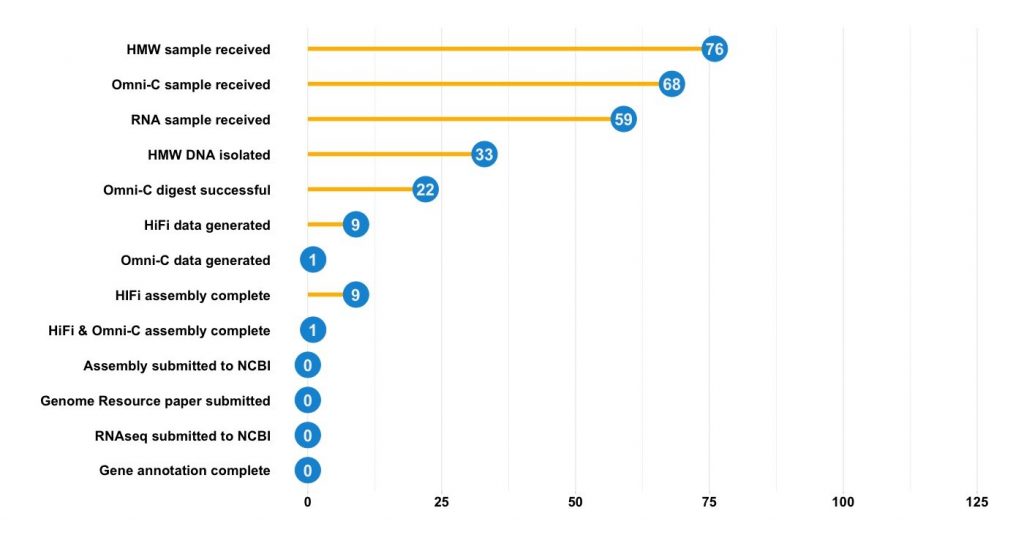
Last week, the California Conservation Genomics Project launched a new tracking system to keep up with the progress of their reference genomes assemblies (https://www.ccgproject.org/reference-genomes-tracking). With over 100 new species being sequenced, this website tracker will show you the progress of each of the key steps.

The first HiFi reads for a MariNet genome reference genome were finalized over a week ago, we are well on our way to having a chromosome-level genome of Mytilus californianus. Thread your byssals around that news!

Number of species completed (as of March 5, 2021)